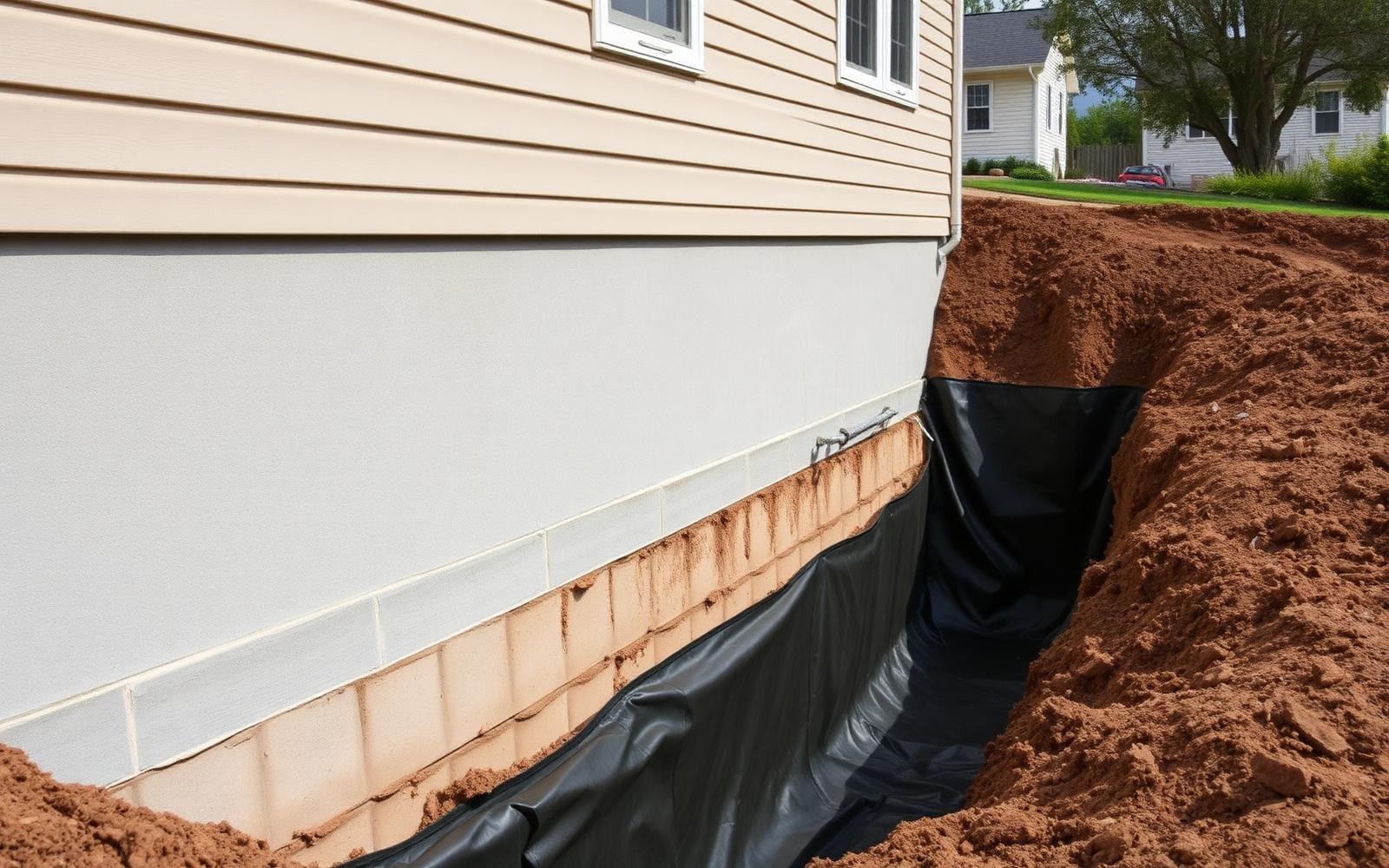
What Causes Wet Basements in Reading?
Reading combines two difficult conditions: significant topography and very dense attached housing. Streets climbing toward Mount Penn shed runoff quickly onto the blocks below, and rowhomes with no side yards give that water nowhere to go except against foundation walls. The uphill house's overflow becomes the downhill house's basement problem.
The city's infrastructure is aging too. Buried downspout lines, area drains and lateral connections installed generations ago are frequently collapsed, root-filled or disconnected entirely, so roof water that homeowners assume is being carried away is actually discharging into the soil right beside the wall.
Foundations here are mostly stone, brick or early block, with shallow cellars and limited headroom. In the surrounding Berks County townships — Exeter, Muhlenberg, Wyomissing, Spring — mid-century block and newer poured foundations bring the more familiar cove-joint and crack cases.
Reading Housing Stock and Foundation Types
Dense city rowhomes
Attached blocks mean interior drainage is nearly always the method. Working room is tight, materials come in and out through the house, and coordination with neighbors matters when a party wall is involved.
Hillside properties
Homes on the slopes toward Mount Penn and in the northern neighborhoods take concentrated runoff on the uphill wall. Interception uphill of the house — grading, curtain drains — often does more than anything applied to the foundation.
Stone and brick cellar walls
Eroded lime mortar transmits water broadly through the wall. Repointing plus a liner tied into drain tile outperforms surface sealants on these walls every time.
Suburban block and poured foundations
In Wyomissing, Exeter and Muhlenberg, block core water and poured-wall shrinkage cracks are the routine cases, often fixable with targeted work rather than a full system.
Local Soil, Drainage and Weather Conditions
- Steep street grades concentrating runoff onto downhill properties
- Very dense attached housing with no exterior excavation access
- Collapsed or disconnected century-old buried drain lines
- Aging combined sewers that can surcharge during downpours
- Stone and brick foundations with deteriorated lime mortar
- Shallow cellars with limited headroom for equipment
- Schuylkill River and creek corridors raising local groundwater
- Freeze-thaw cycling on exposed hillside foundation walls
Most Common Basement Problems in Reading
- Water rushing in during downpours from the uphill side
- Seepage along a shared rowhome party wall
- Wet spot below a downspout that appears to drain nowhere
- Damp, crumbling mortar in a stone cellar
- Water backing up through a cellar floor drain
- Musty basement used for laundry and storage
Basement Waterproofing Cost in Reading
| Work | Typical range | What drives the price |
|---|---|---|
| Interior drainage, rowhome cellar | $3,500 – $7,500+ | Footage, headroom, material access through the house |
| Full perimeter interior system | $6,000 – $10,500+ | Party walls, new pit, wall liner |
| Repointing and parging stone walls | $10 – $28+ per sq ft | Mortar condition and wall area |
| Buried downspout line replacement | $800 – $3,500+ | Run length, hardscape crossings, discharge point |
| Uphill interception / curtain drain | $1,500 – $6,000+ | Slope, run length, outlet availability |
Actual prices vary based on basement size, foundation type, water source, access, drainage requirements, excavation needs and chosen waterproofing method. Compare methods statewide in the Pennsylvania cost guide.
Neighborhoods and Nearby Areas Covered
Professionals in the network serve Reading, Wyomissing, West Reading, Mount Penn, Exeter Township, Muhlenberg, Shillington, Sinking Spring, Kutztown, Birdsboro, Fleetwood, Boyertown and surrounding Berks County communities.
Areas & ZIP Codes We Serve
Serving homeowners throughout Berks County, including 19601, 19602, 19604, 19605, 19606, 19607, 19608 and 19610, plus surrounding communities. Local area codes are 610 / 484 — enter your ZIP code in the form and your request goes to a professional who works in Reading regularly.
Which service do you need?
Frequently asked questions
- Water pours in during downpours but not light rain. Why?
- That is surface water, not groundwater. On Reading's grades, heavy rain produces overland flow that arrives fast. Check gutters, buried downspout lines and the grade uphill of the house first — those fixes are the cheapest available.
- How do I know if my buried downspout line is broken?
- Run a hose into the downspout and watch. If water backs up at the top, pools near the wall, or never appears at the outlet, the line is compromised. It is one of the most common hidden causes in the city.
- Can anything be done if my rowhome has no yard at all?
- Yes. Interior drainage is designed for exactly this situation and requires no exterior access. Roof water routing can usually be improved even in a very tight footprint.
- My neighbor's water seems to be causing my leak. What now?
- Start with a conversation — a redirected downspout costs almost nothing. Interior drainage on your side of the party wall handles the water regardless of who is contributing it.
- Is a stone cellar wall worth repointing before drainage?
- They are usually done together. Repointing stabilizes and reduces through-wall seepage; drainage handles what still gets through and everything arriving at the footing.